"Can you put them on hold for a second?" is one of the most ordinary requests in any office. What happens next depends entirely on which kind of hold gets used, and most people never think about it until the moment it actually matters, when the caller is stuck waiting because the wrong option was chosen without anyone realizing there were two.
Call Hold: Simple, but Tied to One Phone

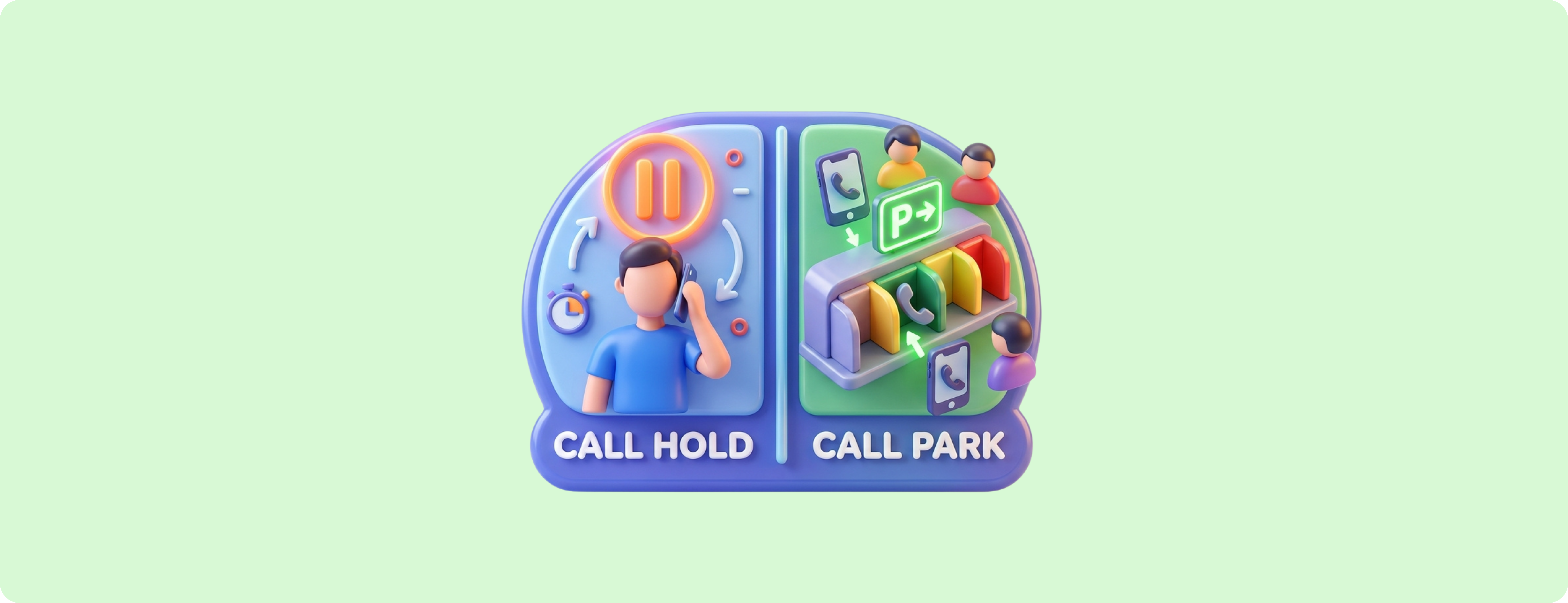
Call Hold does exactly what it sounds like. Pressing hold pauses the call on that specific phone, and the only way to pick it back up is from that same phone. If the person who placed the call on hold needs to step away, hand the call to someone else, or move to a different desk, the call stays exactly where they left it, waiting for them and only them to return.
This works fine when the same person who answered the call is also the one who will finish it. The moment a call needs to be picked up somewhere else, Call Hold becomes a limitation rather than a convenience.
Call Park: The Same Idea, Freed From One Phone

Call Park solves that exact problem. Instead of holding a call on a single device, parking a call sends it to a shared parking spot in the system, given its own extension number. Anyone in the office can then retrieve that same call from any phone by dialling that extension, whether they are at their own desk, someone else's, or a phone in a completely different room.
That single difference changes what is actually possible during a call. A call no longer has to stay tied to the person or the device that first answered it.
What This Looks Like in Practice

Picture a small real estate office. A client calls in with questions only one of the agents can answer, but every agent is currently out showing properties. The receptionist parks the call on extension 5801, then lets the agents know over their cellphones or the office intercom that a client is waiting on that extension. Whichever agent gets free first dials 5801 from any phone, desk or mobile, and picks up exactly where the receptionist left off.
If the call sits parked too long without anyone picking it up, it can also be set to ring back automatically, with a distinct ringtone that makes it clear this is a returning parked call rather than a new one coming in. This ringback behaviour applies to standard, static call parks; it is not available when a call is parked dynamically, without a specific extension assigned.
None of this would be possible with a simple Call Hold. The call would still be sitting at the receptionist's desk phone, waiting for a single person to come back to it.
Choosing Between Them
- Use Call Hold when the same person answering the call will also be the one to finish it, and there's no need for anyone else to pick it up.
- Use Call Park when a call might need to be picked up by someone else, from somewhere else, whether that's a different desk, a different department, or a colleague who happens to be free first.
Experience the Difference Today
The difference between these two options rarely gets explained until someone runs into it the hard way: a call left waiting because the person who could help was two desks over and had no way to reach it. Knowing which one to reach for is a small thing that quietly determines whether a caller feels handled smoothly or left waiting on hold for no good reason.

.png)


.png)